Origin story
How CommiShare Was Born
A love story involving meatballs, mild social anxiety, and a database.
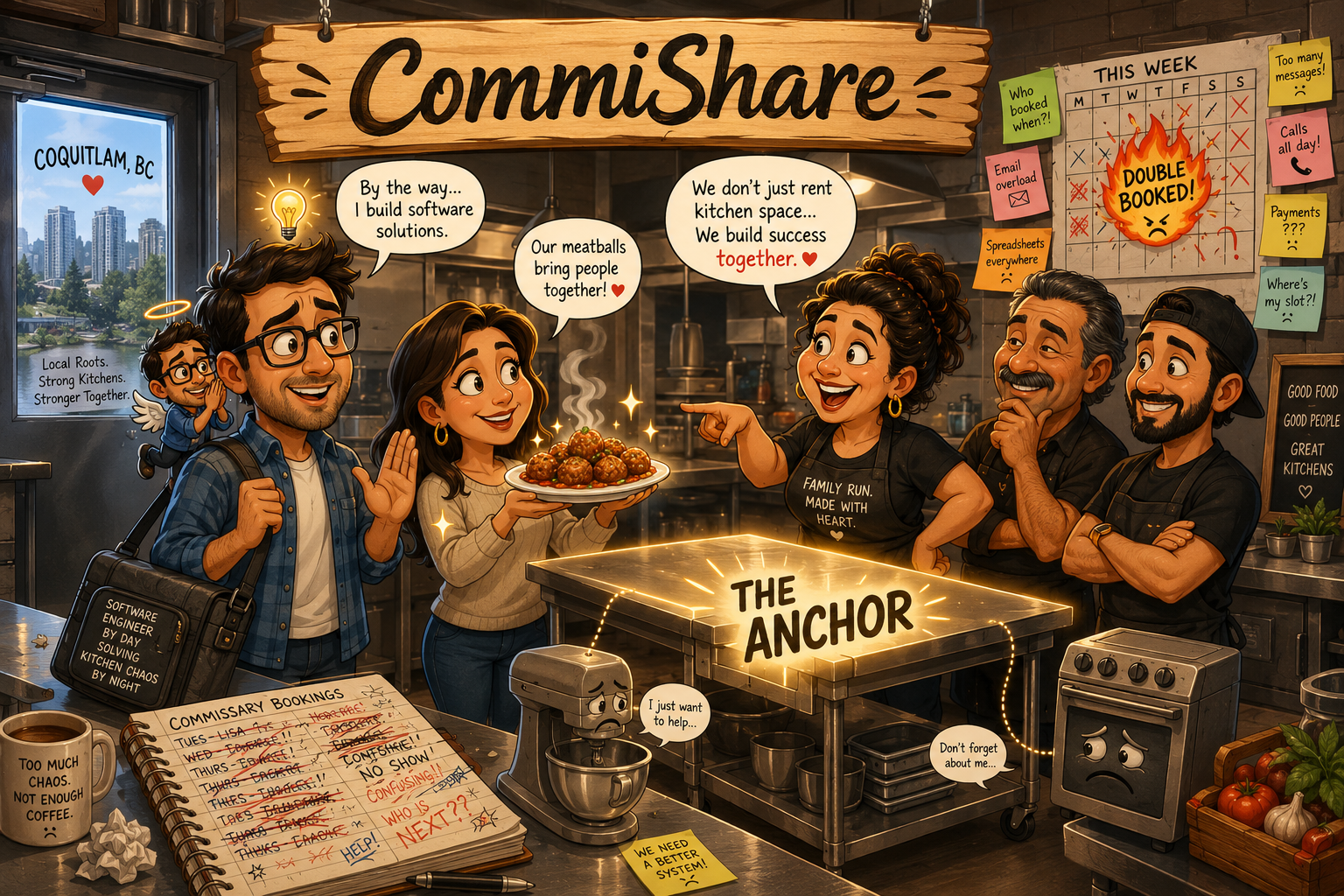
It started with meatballs.
Not just any meatballs - my wife's meatballs. The recipe she's been quietly perfecting while I pretended to understand the difference between oregano and marjoram. These meatballs deserved a future. And in British Columbia, a meatball's future does not happen in your home kitchen. The rules are clear: if you want to sell food, you cook in an approved commercial space. No exceptions, no "but they're really good meatballs, officer."
So began The Great Commissary Kitchen Tour.
We visited several. Some were enormous industrial cathedrals of stainless steel, staffed by people who greeted us with the warmth of a parking meter. Sign here. Initial there. Stations are first-come, first-served, good luck, next. Everything worked, and nothing felt like anywhere you'd want your meatballs to grow up.
Then we drove out to Coquitlam.
We found a small, family-run commissary kitchen - the kind of place where the owners actually cook, know every member by name, and can tell you exactly who left the convection oven a mess last Tuesday. Likeable, honest people. The sort you trust with a recipe and a secret. We talked about my wife's approval, the process, the space. It was going well. We were wrapping up. Coats were basically on.
And then - right at the door, mid-goodbye - a little voice in my head cleared its throat.
"Psst. You. Yes, you. You're a software solutions engineer. These lovely people run an entire business. Statistically, something is on fire. Say something before you walk out and regret it in the car."
So, with the smoothness of a man defusing a bomb he isn't sure is a bomb, I said: "By the way - I'm a software engineer and solutions architect. If you ever need help with any of your systems, I'd be glad to lend a hand."
I braced for the polite nod. The "oh, nice, thanks."
Instead, something changed in the room. The owners looked at each other with the specific expression of people who have been waiting a long time for someone to say exactly that.
"...Actually," they said.
Reader, "actually" is the most beautiful word in business.
Turns out the whole operation ran on the ancient and terrifying technology of A Notebook. Bookings scribbled by hand. Double-bookings discovered the hard way, at 6 a.m., by two people who both "definitely booked the big table." No-shows nobody tracked. Members quietly negotiating equipment rights like it was a hostage situation. Quota tracked mostly by vibes and the honor system, which - surprise - is neither honorable nor a system.
But here's the part that sold me: they weren't clueless. They knew exactly what was broken.
One of the managers had worked in another commissary kitchen before, and - crucially - had used a real kitchen booking app there. She knew what these systems could do. She knew what she loved, what she'd throw in the ocean, and what she'd want done properly this time. This was not a client saying "make it good." This was a domain expert handing me a spec written in blood and experience.
And then she taught me The Rule
I was sketching out the obvious model in my head - members book stations, tables and equipment, all equal citizens, clean and tidy. I opened my mouth to propose it.
She stopped me.
"No. The table is the anchor."
I blinked.
She explained it the way only someone who's lived it can. In a commissary kitchen, you don't just "book the stand mixer." A stand mixer, floating alone in space, is nothing - it's a lonely appliance with no purpose and nowhere to belong. You book a table. The table is your home base, your claimed territory, the reason you're even there. The equipment only makes sense attached to a table booking. Book a table, then pull the mixer, the oven, the whatever, into that. No table, no equipment. The table is the parent; everything else is a dependent child that cannot be trusted to live on its own.
I sat there slightly stunned, because she had just described, in plain kitchen English, a parent-child data relationship cleaner than half the architecture diagrams I'd seen in enterprise meetings. She didn't know the words parentBookingId or "foreign key." She didn't need to. She knew the domain, and the domain was telling me how to build the schema.
That single sentence - the table is the anchor - became the backbone of the entire app. Only table bookings count against your monthly quota. Equipment rides along for free, because equipment without a table is just furniture with delusions of grandeur.
So we made a deal
Not a cash contract. A barter - which, if you think about it, is the most on-brand possible way to build software for a shared kitchen. I'd build them a proper booking and management system, shaped by their real workflow and the manager who already knew the shape of the problem. In return, they'd give me something money can't: a real business, real users, real chaos to tame, a live testbed to prove the thing actually works - and, fittingly, a home for the meatballs that started all of this.
Everyone brought what they had. Nobody wrote a big check. Which is, when you get down to it, the entire philosophy of a commissary: shared space, shared tools, shared benefit. We just extended it to the software.
And that's how CommiShare got its name, its purpose, and its very first rule - the one about the table.
The meatballs, I'm happy to report, are thriving. ■